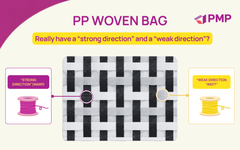
What quality tests does a PP woven bag need to pass before leaving the factory?
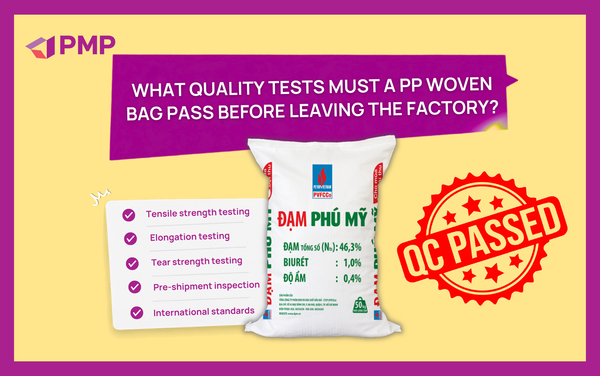
A PP woven bag does not become ready for shipment simply because it has been woven, cut, and sewn into its final shape.
Before reaching the customer, each production batch must pass a series of quality checks covering strength, durability, appearance, safety, and compliance.
In this article, PMP takes a closer look at five key quality checks and the international certifications and standards (including FSSC 22000, ISO, HALAL, and EN 15343) that may be required for woven PP packaging before it leaves the factory.
So, what exactly is tested, and what does it take for a PP woven bag to meet quality requirements? Let’s take a closer look.
1. Tensile strength testing
Polypropylene (PP) is well known for its excellent tensile strength. To ensure that every production batch meets the required specifications, samples are randomly selected and tested using specialized tensile testing equipment.
The test measures how much tensile force the woven fabric or finished bag can withstand before breaking or failing.
This helps manufacturers verify that the bags can safely withstand the loads they are designed to carry during filling, stacking, handling, and transportation.
2. Elongation testing
A high-quality bag needs to be strong, but it should also be able to withstand stretching without undergoing excessive or permanent deformation.
During elongation testing, a sample is stretched under a specified load and the results are compared against the applicable requirements.
This helps ensure that the woven fabric maintains its structural integrity when the bag is subjected to pressure during storage, stacking, handling, or transportation.
3. Tear strength testing
Tensile strength and tear strength measure different aspects of a bag's performance.
A PP woven bag may have good overall tensile strength but can still be vulnerable to tear propagation if it has a small cut, puncture, or other weak point.
Tear strength testing helps identify potential weaknesses and evaluates how well the material can resist the further propagation of a tear.
This is particularly important in real-world applications, where bags may be exposed to rough handling, loading, unloading, and transportation.
4. Pre-shipment inspection
Before shipment, each finished batch is carefully inspected to ensure that the bags meet both quality requirements and customer specifications.
Typical inspection points include:
- Checking for broken or loose yarns, excess yarn, and areas of loose weaving that may create openings or weak spots
- Verifying printed graphics, colors, text, and overall print quality
- Inspecting the appearance to ensure the bags are clean and free from dirt, moisture, tears, or other visible defects
- Comparing the tensile and elongation performance of the woven fabric against applicable national or international specifications
- Checking that each finished package has passed the required KCS quality inspection
- Verifying that the transportation vehicle meets the required delivery conditions
- Checking that transportation materials such as pallets, wooden supports, and floor liners meet the required quantity and quality specifications
These checks help ensure that the products leaving the factory are consistent, properly packed, and ready for delivery.
5. International standards and certifications
If quality tests are the individual "exams" a PP woven bag must pass, compliance with recognized international standards and certifications is the final qualification for a packaging manufacturer serving global markets.
At PMP, quality is monitored throughout the production process, while our manufacturing systems are continuously improved to meet international requirements and maintain consistent quality from batch to batch.
Depending on the application and target market, relevant certifications and standards may include:
- FSSC 22000 – A food safety management certification that helps ensure packaging meets stringent food safety requirements, particularly for packaging intended for direct food contact. It covers controls throughout the production process, from incoming raw materials to the finished product.
- ISO 9001 – A quality management system standard that provides a structured framework for controlling production processes and maintaining consistent product quality.
- ISO 45001 – An occupational health and safety management system standard designed to support a safer working environment and reduce workplace-related risks throughout manufacturing operations.
- ISO 14001 – An environmental management system standard that demonstrates a company's commitment to managing and reducing the environmental impact of its operations.
- HALAL – Certification demonstrating that products and manufacturing processes meet applicable Halal requirements, helping packaging suppliers serve customers and markets with specific religious compliance requirements.
- EN 15343 – A standard related to the traceability of recycled plastics and the verification of recycled content, supporting greater transparency in recycled-material claims and sustainable packaging practices.
Frequently asked questions:
What certifications are required for PP woven bags intended for export?
The requirements depend on the target market, end-use application, and customer specifications.
Common certifications and standards may include FSSC 22000 for food-related applications, ISO 9001, ISO 14001, and ISO 45001. For markets with specific religious requirements, HALAL certification may also be required. Where recycled content and traceability are important, standards such as EN 15343 may apply.
The exact requirements should always be confirmed based on the destination market and intended application.
What is the difference between FSSC 22000 and ISO 9001?
ISO 9001 focuses on quality management across an organization's processes. It provides a general framework for controlling processes and maintaining consistent quality.
FSSC 22000, on the other hand, focuses specifically on food safety management. It is particularly relevant to packaging manufacturers supplying packaging intended for food applications, including direct food contact packaging where applicable.
Why is tear strength tested separately from tensile strength?
Because they measure different types of material performance.
Tensile strength measures how much force the material can withstand when it is pulled under controlled conditions.
Tear strength evaluates the material's resistance to the propagation of an existing tear or cut.
In real-world applications, this distinction is important because a bag may withstand its intended load but still be vulnerable to tearing if it has a small puncture or cut.
Does a PP woven bag need to be tested for every production batch?
Yes, quality control is generally carried out on a batch-by-batch basis, with samples selected according to the manufacturer's quality control procedures and applicable customer or standard requirements.
This approach helps verify consistency between production batches rather than relying solely on a one-time assessment of the manufacturing process.
If you are looking for a woven PP packaging supplier with professional technical expertise, modern printing capabilities, and experience serving international markets, PMP is ready to work with you to develop the packaging solution that best fits your product and market requirements.